

.svg)

Patient Preference Information (PPI) has gained prominence in patient engagement as a robust method for capturing specific patient needs, perspectives, and priorities by identifying the criteria that matter most in specific decision-making scenarios.
Rationale and benefits of PPI
- PPI can inform regulatory and HTA decisions, ensuring resources are allocated to innovations that truly matter to patients.
- PPI empowers patients and physicians to improve shared decision-making by understanding the criteria that influence preferences, helping to identify the most suitable treatment options.
- PPI enable developers to tailor innovations to the patient's perspective and needs making them more effective.
In 2022, the EMA CHMP recognized the use of a framework developed by the IMI PREFER initiative for selecting appropriate PPI research methodologies. This marked a significant milestone toward the routine integration of PPI in regulatory decision-making. Further progress is anticipated with the development of an ICH guideline, expected to be adopted by December 2026.
We at admedicum strongly believe in the power of PPI and are proud of our recent patient preference research in the field of benign prostatic hyperplasia (BPH) – the PREFPRO-study

When conservative treatments for BPH are no longer effective, patients face a choice among various surgical options, each with distinct risks and benefits. This complexity makes the decision highly dependent on individual preferences.
Sponsored by Boston Scientific, executed by admedicum, and conducted in collaboration with clinical experts and patients, the PREFPRO study used a Discrete Choice Experiment (DCE) to explore patient preferences for surgical treatment of BPH.
A key prerequisite for this study, and meaningful PPI data collection in general, is a comprehensive understanding of the decision-making context. While some elements may be found in literature, many are not. Therefore, qualitative interviews with people affected were conducted to explore the real-world decision scenario and decision criteria for the DCE in the online survey.
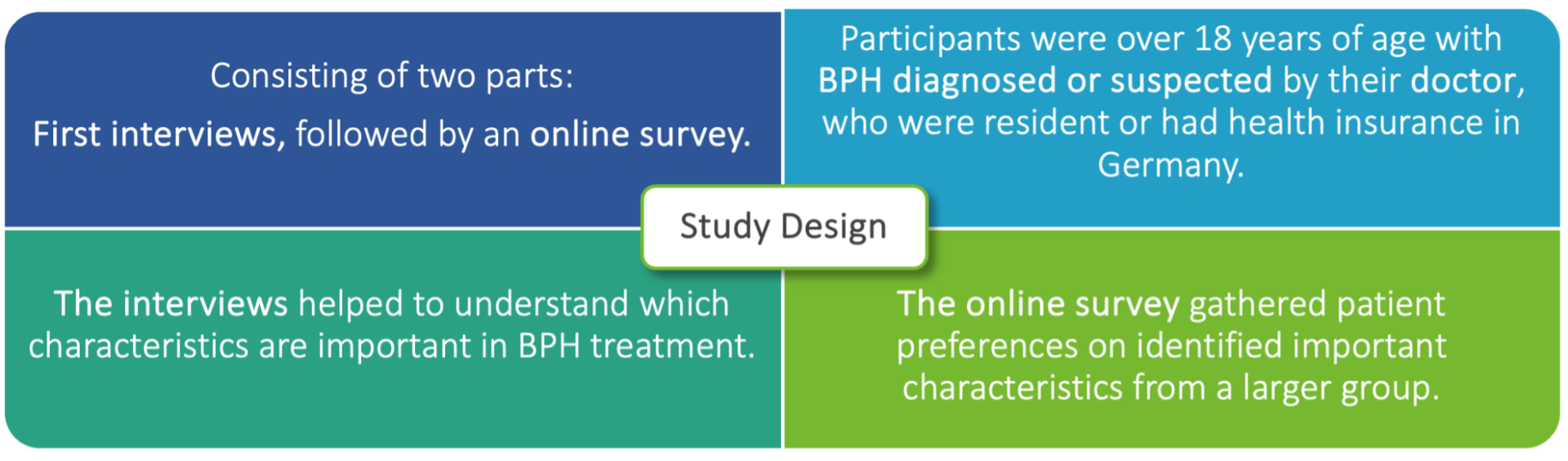
To ensure clarity and ease of participation, the online survey was pre-tested.
Key Learnings
The contributions of over 300 patients provided valuable insights, including:
- Patients’ characteristics, especially those related to sexual health, play a critical role in shaping BPH treatment preferences.
- Top 3 most relevant treatment characteristics were:
- Reduction of the probability of ejaculatory dysfunction
- Reduction of the urgency of urination
- Reduction of the frequency of urination during the night
- The impact of BPH on patients’ emotional well-being and daily life – especially due to sleep disturbance – is substantial and deserves serious attention.
- Current clinical information in BPH treatment often emphasizes technical aspects chosen by clinicians, potentially overlooking individual patient’s priorities.
Our findings can help physicians appreciate the diversity of patient preferences, and support the development of decision aids to enhance patient information, communication, and personalized care.
The importance of effectively supporting the decision-making process is further emphasized by the wide range of treatment characteristics that make choosing a BPH therapy anything but trivial.

Utilization of results
To ensure accessibility and utility, the study results were published in a scientific journal, enabling stakeholders to share findings with regulatory and HTA bodies for consideration in healthcare decisions[1].
The results were also disseminated through various channels, including the popular podcast 'Pinkelpause' with Dr. Christoph Pies, conferences, and local practices, fostering improved shared decision-making between patients and physicians.
Finally, a summary report was provided to study participants and the broader patient community to increase awareness on the multitude of treatment characteristics and the importance to share individual treatment preferences.
[1] Vennedey, Vera; Holling, Heinz; Steiner, Thomas; Schrader, Mark; Grossmann, Heiko; Hoenig, Christian. Patient Preferences for Surgical Treatments for Benign Prostatic Hyperplasia: A Discrete Choice Experiment. JU Open Plus 2(11):e00116, November 2024. | DOI: 10.1097/JU9.0000000000000226
“This patient preference research unveiled quantifiable patient preference information that has the potential to improve health care outcomes for many men. With this project Boston Scientific underlined their patient centricity and willingness to improve health care provision for BPH patients with scientific robust non-product focused evidence.”
Christian Hoenig – Director Patient Engagement at admedicum
“The preference study provided valuable insights for us into what patients really value about therapies. The results can support our HTA processes and provide structured, robust evidence about the patient perspective about the surgical treatment of BPH. Most importantly we communicate the results to clinicians as the findings should inform medical decision making in clinical practice.”
Dr. Claudia Griebel - Health Economics and Market Access Manager DACH at Boston Scientific
Future Directions
The journey does not end here. The insights gained must be leveraged to develop official decision-support tools that further facilitate shared decision-making between patients and physicians and insights should inform updates to treatment guidelines, future regulatory and HTA decisions, and industry developments.
Why we do what we do at admedicum
At admedicum, we firmly believe that real patient involvement is not only possible but essential. For almost 10 years, we have been bringing together people living with chronic and rare diseases with companies, researchers, and healthcare providers – as equals. Because only together can we create solutions that truly make a difference.
Want to learn more about patient preference research, please contact us. We are eager to collaborate and explore how to support you best.
Contact Information
Christian Hoenig, Director, Patient Engagement
christian.hoenig@admedicum.com
Dr. Vera Vennedey, International Patient Engagement Manager