
Back to All Case Studies
Commercialization
HEOR & Market Access
Patient Engagement & Advocacy

Enhancing Decision-Making with Patient Preference Information
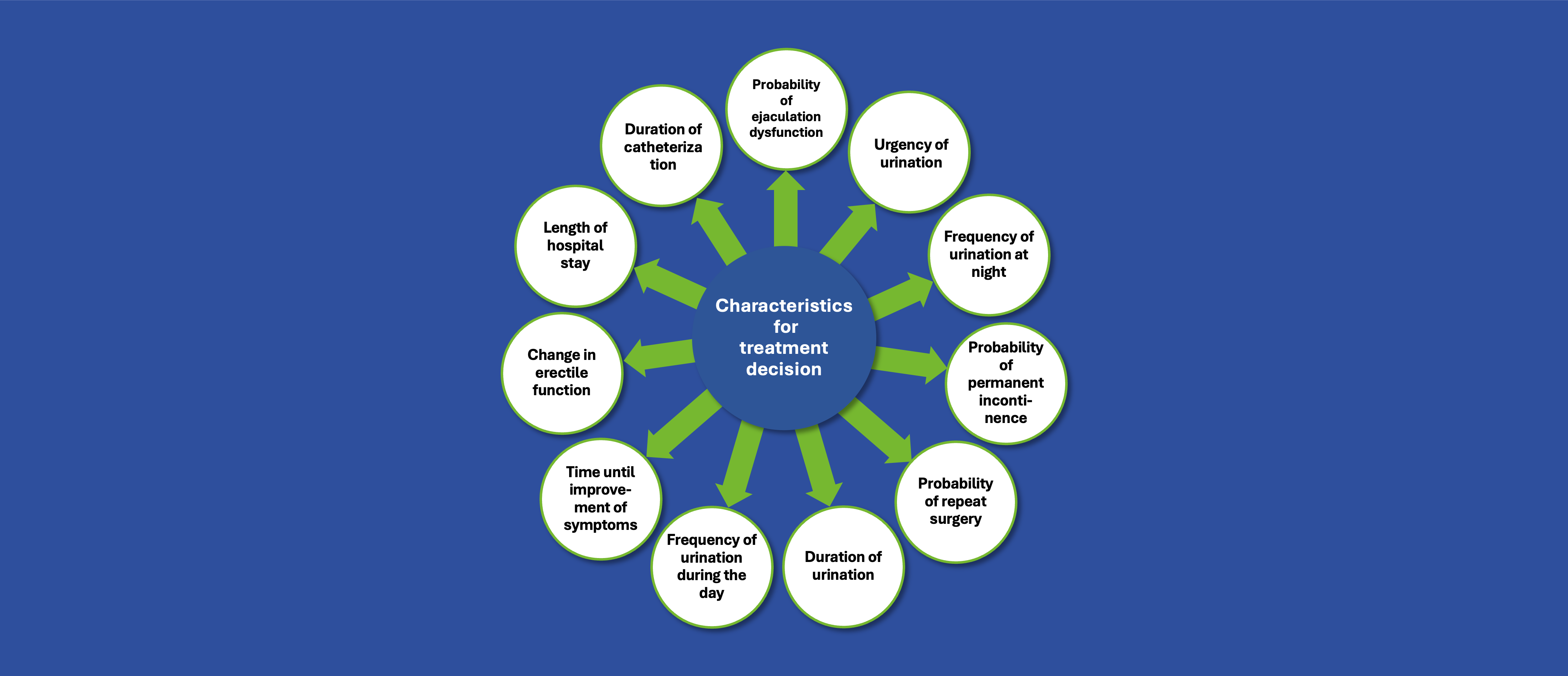
How patient preference research supported shared decision-making and informed regulatory and HTA-relevant evidence in benign prostatic hyperplasia (BPH).

Situation

Patient Preference Information (PPI) has gained increasing relevance as a structured approach to capture what truly matters to patients when facing complex treatment decisions. In benign prostatic hyperplasia (BPH), patients often need to choose among multiple surgical options with different risks and benefits, making decisions highly dependent on individual priorities. However, traditional clinical information often focuses on technical outcomes and may not fully reflect patient needs and perspectives.

Objective

The PREFPRO study, sponsored by Boston Scientific, aimed to generate robust, quantifiable patient preference information for surgical treatment of BPH. The project sought to better understand which treatment characteristics are most relevant to patients, support shared decision-making between patients and physicians, and provide evidence that could inform regulatory, HTA, and clinical decision-making.

Our Solution

1
Patient-centered study design: Qualitative interviews were conducted to explore real-world decision-making scenarios and identify treatment characteristics relevant to patients with BPH. These insights formed the foundation for a Discrete Choice Experiment (DCE).
2
Robust preference elicitation methodology: The PREFPRO study applied a DCE to systematically quantify patient preferences for surgical treatment options, ensuring methodological rigor and relevance for decision-making contexts.
3
Broad patient involvement: Over 300 patients with diagnosed or suspected BPH participated, providing diverse perspectives and strengthening the validity of the results for real-world application.
4
Clear communication of results: Study outcomes were translated into accessible insights for physicians, patients, and other stakeholders to support informed and shared treatment decisions.

Outcomes and Impact

1
Identification of key treatment drivers: The study revealed that patients prioritize reduction of ejaculatory dysfunction risk, urgency of urination, and nocturnal urinary frequency when considering surgical treatments.
2
Improved understanding of patient priorities: Emotional well-being, sleep disturbances, and daily life impact emerged as highly relevant factors, highlighting gaps in how treatment information is often communicated.
3
Support for shared decision-making: Results demonstrated the importance of incorporating patient preferences into clinical discussions and decision aids for BPH treatment.
4
Regulatory and HTA relevance: The results provided Boston Scientific with structured patient-centered evidence relevant for HTA processes and regulatory decision-making in the context of BPH.

“The preference study provided valuable insights for us into what patients really value about therapies. The results can support our HTA processes and provide structured, robust evidence about the patient perspective about the surgical treatment of BPH. Most importantly we communicate the results to clinicians as the findings should inform medical decision making in clinical practice.”

Dr. Claudia Griebel
Health Economics and Market Access Manager DACH at Boston Scientific

Conclusion

By leading and conducting the PREFPRO study, admedicum turned patient perspectives into robust, quantifiable evidence for BPH treatment decision-making. The study combined patient-centred design with methodological excellence and generated insights that are relevant for HTA and regulatory processes, while also supporting more informed and shared decision-making in clinical practice.

Vennedey, Vera; Holling, Heinz; Steiner,Thomas; Schrader, Mark; Grossmann, Heiko; Hoenig, Christian. Patient Preferences for Surgical Treatments for Benign Prostatic Hyperplasia: A Discrete Choice Experiment. JU Open Plus2(11):e00116, November 2024. | DOI: 10.1097/JU9.0000000000000226

Get in Touch
We’re here to support your goals in patient engagement and access. Reach out to start a conversation with our team.
Contact us

Related Case Studies